24 Seamless Halftone Dot Patterns: A Practical Resource for Designers and Print Professionals
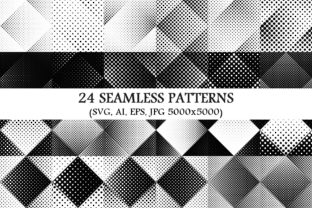
Halftone dot patterns remain a foundational visual technique—rooted in analog printing but widely adapted across digital design, branding, packaging, apparel, and editorial work. The 24 Seamless Halftone Dot Patterns package delivers a curated set of 24 distinct, mathematically consistent halftone arrangements—each designed to tile without visible seams across any surface or resolution. Unlike generic dot textures generated algorithmically in real time, these are hand-tuned vector-based patterns that preserve fidelity at any scale, whether printed on fabric at 300 DPI or displayed full-screen on a 5K monitor.
What Sets This Collection Apart from Other Dot-Based Resources
Not all dot patterns serve the same purpose—and not all “seamless” assets behave predictably in production. The 24 Seamless Halftone Dot Patterns package stands out because it combines three practical attributes rarely found together: consistency in dot geometry, format versatility, and intentional variation in tone and rhythm. Each pattern is built using precise vector paths—not raster approximations—so scaling introduces no pixelation or aliasing. That makes them especially reliable for applications where precision matters: engraved signage, laser-cut templates, screen-printing separations, or SVG-based web animations.
The 24 variations cover a thoughtful spectrum: from tight, high-frequency dots (ideal for subtle texture overlays) to loose, expressive clusters (suited for retro poster backgrounds). Importantly, they avoid the “flatness” common in automated halftone filters—each pattern maintains optical balance through deliberate spacing, edge softness, and dot shape nuance (circular, elliptical, slightly tapered). This attention to perceptual detail helps maintain legibility when layered over photos or text, a frequent pain point with off-the-shelf halftone generators.
How It Compares Across Formats and Use Cases
Format availability directly impacts workflow integration. The 24 Seamless Halftone Dot Patterns includes native vector files (SVG, AI, EPS) alongside high-resolution JPGs (5000×5000 pixels). That combination bridges gaps between disciplines: SVG suits web developers needing lightweight, responsive background fills; AI and EPS support designers working in Adobe Creative Suite for print-ready layouts; JPGs provide immediate drag-and-drop utility in non-vector tools like Figma, Canva, or Affinity Photo.
In contrast, many free or low-cost dot pattern libraries offer only raster formats—limiting scalability—or single-format downloads that lock users into one ecosystem. Others rely on procedural generation, which may produce visually interesting results but lacks repeatability: two exports of the “same” pattern can vary subtly due to algorithmic randomness. With the 24 Seamless Halftone Dot Patterns, every file is deterministic, version-controlled, and documented—critical for brand asset management or multi-stage production pipelines.
Strengths and Real-World Fit
The collection excels in scenarios demanding reliability, reproducibility, and cross-medium compatibility. For example:
- A packaging designer building a sustainable product line might use one of the looser halftone patterns as a subtle background on recycled kraft paper—scaling the SVG to match die-cut dimensions without loss.
- An editorial art director developing a magazine’s visual identity could layer a mid-frequency halftone over photography to unify disparate image sources while preserving tonal range.
- A motion graphics artist animating a logo reveal might import the SVG into After Effects, applying stroke growth or opacity transitions to individual dot groups—something impossible with flattened JPGs.
Because all 24 patterns share the same underlying grid logic and tiling behavior, mixing and matching them within a single project remains coherent. You won’t encounter mismatched densities or conflicting alignments—a common issue when combining third-party halftones from different sources.
Tradeoffs and Situational Limitations
No resource fits every need—and understanding where the 24 Seamless Halftone Dot Patterns falls short is just as important as knowing where it shines. First, it is intentionally monochrome and grayscale-focused. There are no color variants, gradients, or mixed-tone hybrids. If your project requires duotone effects, CMYK process halftones, or RGB-specific dithering, this collection doesn’t extend into those domains.
Second, it prioritizes structure over spontaneity. These are not organic, hand-drawn textures—nor are they meant to mimic ink bleed, paper grain, or screen wear. If authenticity of imperfection is central to your aesthetic (e.g., zine-style collage or lo-fi branding), you’ll likely supplement these patterns with scanned artifacts or noise layers.
Third, while the 5000×5000 JPGs are ample for most print and web uses, they aren’t optimized for ultra-large-format output like billboards or architectural wraps beyond ~3 meters wide at viewing distance—where custom-built, tileable raster tiles or procedural generation may offer more flexibility.
When to Choose This—And When to Look Elsewhere
The 24 Seamless Halftone Dot Patterns is most valuable when you need predictable, production-ready halftones across multiple deliverables, teams, or platforms. It suits professionals who value time savings in asset preparation, consistency across touchpoints, and minimal post-processing. Think: agencies maintaining brand guidelines, in-house design teams supporting marketing campaigns, or illustrators building reusable texture libraries.
It’s less ideal if you’re exploring experimental halftoning—say, simulating stochastic screening, variable data printing, or AI-assisted pattern synthesis. Those pursuits benefit more from parametric tools (like Illustrator’s built-in halftone effects, specialized plugins, or Python-driven generative workflows) where control over dot distribution, angle, size modulation, and error diffusion is dynamic and iterative.
Similarly, if your work centers on rapid prototyping in collaborative tools like Figma or Miro, and you rarely export final assets at print resolution, a smaller, free SVG halftone set may suffice—especially if your needs are limited to mockups or UI overlays. The 24 Seamless Halftone Dot Patterns delivers measurable ROI when used repeatedly across real projects—not just as a one-off decorative flourish.
Practical Integration Tips
To maximize utility, consider how you’ll embed or adapt these patterns in your existing tools:
- In Adobe Illustrator: Drag an AI or EPS file onto your artboard, then use Object > Pattern > Make to convert it into a swatch. Adjust spacing and overlap directly in the Pattern Options panel—without altering the original vector geometry.
- In CSS or Web Design: Reference the SVG files directly in background-image declarations. Because they’re lightweight and scalable, they load faster than equivalent JPGs and respond cleanly to media queries.
- In Photoshop or Affinity Photo: Place the 5000×5000 JPGs as smart objects. Use blending modes like Multiply or Overlay to integrate them with photographs while preserving highlight and shadow detail.
- For Physical Output: When prepping for screen printing or engraving, isolate each pattern in its native vector format and confirm dot size against your printer’s minimum line width specification—most patterns in this set accommodate standard 12–60 LPI (lines per inch) requirements.
Finally, keep version control in mind. Since the package includes identical patterns across three vector formats, choose one primary source (e.g., SVG for web, AI for print) and retain the others as backups—not duplicates. That avoids confusion during handoff or archiving.
Making a Grounded Decision
Evaluating resources like the 24 Seamless Halftone Dot Patterns isn’t about finding the “best” option—it’s about identifying the right tool for your current constraints: timeline, team expertise, output requirements, and long-term reuse potential. If you regularly handle cross-platform design tasks, prioritize scalability and format flexibility, and value repeatable quality over novelty, this collection offers tangible, time-tested utility. If your goals lean toward exploration, customization, or highly specialized technical output, pairing it with complementary tools—or starting from scratch—may better serve your objectives.
Ultimately, the strength of the 24 Seamless Halftone Dot Patterns lies in its restraint: 24 thoughtfully constructed options, delivered cleanly, without bloat or ambiguity. That kind of focused utility is rare—and often more valuable than broader, less curated alternatives.