Cats Patterns and Frames: A Practical Resource for Designers, Educators, and Small Business Creators
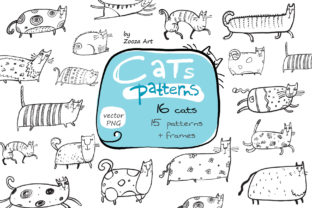
When you need expressive, playful, and production-ready visual assets—especially for children’s products, educational materials, or lighthearted branding—Cats Patterns and Frames delivers a tightly curated, technically sound collection built for real-world use. It’s not just another clipart pack. This is a workflow-integrated toolkit: 16 high-resolution PNG cats (2000×2000 px, 300 DPI), vector EPS and PNG files with white-spot variations, 15 seamless patterns across three distinct styles and five colorways each, seven versatile frames, two wide-format lines, and black-and-white pattern variants—all optimized for print, digital, and textile applications.
How It Fits Into Your Creative Workflow
Designers and small business owners often juggle tight deadlines, multiple output formats, and shifting client or audience expectations. Cats Patterns and Frames reduces friction at several key points in that cycle. Before starting a project—say, designing a line of organic cotton baby onesies—you can preview how the seamless patterns scale across fabric repeats. During layout, the 4000×4000 px frames work as ready-made borders for greeting cards or printable activity sheets. After finalizing a concept, the vector EPS files allow clean resizing for embroidery digitizing or large-format signage without pixelation.
For educators creating classroom resources, the black-and-white PNG patterns (with transparent backgrounds) drop instantly into Canva or Google Slides for custom flashcards or behavior charts. The 16 individual cat illustrations—each with unique posture and expression, including “Run, cat, run!” energy—support storytelling, emotion recognition exercises, or themed lesson plans without licensing risk or attribution overhead.
Practical Integration Across Platforms and Outputs
Compatibility isn’t assumed—it’s engineered. All raster files are delivered at industry-standard 300 DPI resolution, ensuring crisp printing on mugs, copybooks, stickers, and fabric swatches. The vector EPS files retain full editability in Adobe Illustrator, Affinity Designer, or Inkscape, letting you adjust spot colors, isolate elements, or combine cats with custom typography. Seamless patterns come in both color and monochrome versions, so you can adapt to brand guidelines or accessibility requirements without reworking from scratch.
Web designers benefit from the transparent-background PNGs for avatars, loading animations, or interactive UI elements—no need to manually remove backgrounds or wrestle with inconsistent clipping paths. The 8000×2000 px line graphics serve as bold horizontal dividers for websites or social media banners, while the 4000×4000 px frames function equally well as Instagram post templates or printable wall art layouts.
Use Cases That Reflect Real Workflows
- Children’s apparel brands: Apply seamless patterns directly to textile design software (like Spoonflower or Adobe Substance) to preview repeat alignment before ordering fabric samples.
- Educational publishers: Use the black-and-white PNG patterns as coloring page bases—add simple outlines or layer them over learning objectives (e.g., “Count the cats running left”) for differentiated worksheets.
- Small-batch stationery makers: Combine one of the 7 frames with a “Run, cat, run!” illustration to build a cohesive set of thank-you cards, gift tags, and packaging inserts—all consistent in tone and technical quality.
- Bloggers and content creators: Drop a transparent cat PNG into a newsletter header or embed a frame around a featured quote image to reinforce brand personality without custom illustration costs.
- Freelance designers: Keep the vector EPS file open alongside your working document—swap in alternate cats or recolor patterns on the fly when clients request quick iterations.
Preparation and Organization Tips for Long-Term Use
Start by organizing the files by type—not just naming, but folder structure: /patterns/seamless/color/, /patterns/seamless/bw/, /illustrations/png/, /frames/png/, etc. This makes asset retrieval faster during active projects and supports version control if you later add custom edits. Rename files meaningfully: cat-running-left-blue.png rather than cat_03.png.
Test compatibility early. Open one EPS file in your vector editor and confirm text remains editable and layers are intact. Import a seamless pattern into Photoshop and verify tiling works cleanly at 10%, 50%, and 200% zoom—some patterns fail only at extreme scales. For textile use, export a 12-inch square swatch at 300 DPI and check repeat alignment on a physical proof before committing to bulk fabric.
Because all cats are drawn with consistent line weight and stylistic rhythm, they mix well—even across different poses (“how does your cat run?” includes sideways dashes, mid-air leaps, and panicked zigzags). That cohesion means you can build visual hierarchies confidently: use a bold frame for a product hero image, then echo its corner motif in a subtle pattern background behind supporting text.
Quality Control and Consistency Across Applications
The uniform 300 DPI resolution and 4000×4000 px dimensions across frames, patterns, and lines mean no last-minute scaling compromises. You won’t need to upsample a low-res element or compress a file so much it loses detail on a mug wrap. The 16 cats share the same base grid and perspective logic, so combining them into a scene—say, a row of cats racing across a notebook cover—feels intentional, not assembled.
For educators and parents using these for printables, the black-and-white PNGs print reliably on standard inkjet and laser printers. No grayscale conversion surprises. For digital use, the transparent backgrounds eliminate the need for manual masking in tools like Figma or PowerPoint—drag, drop, and adjust opacity or blend mode as needed.
Moving Beyond Decoration Into Functional Design
These aren’t just “funny cats.” They’re functional components. The “Run, cat, run!” theme isn’t just whimsy—it’s kinetic energy you can harness. Use the sprinting cat pose to signal urgency in a progress tracker. Place the wide-format lines beneath headings to create visual momentum in presentations. Layer a subtle seamless pattern behind body text to add texture without compromising readability.
Because the collection includes both full-color and monochrome variants, you maintain flexibility across mediums: vibrant for kids’ apps, restrained for teacher resource PDFs, bold for retail signage. And because everything ships in multiple formats (EPS, PNG, JPG), you avoid platform lock-in—no dependency on proprietary file types or subscription-based libraries.
If you’re evaluating whether Cats Patterns and Frames fits your current or upcoming work, ask: Do I need assets that work across print, web, and product? Do I value consistency in style and technical specs over quantity? Do I prefer spending time designing—not prepping, converting, or troubleshooting files? If yes, this collection operates as infrastructure, not decoration: reliable, adaptable, and quietly efficient.