Watercolor Ballet Patterns Set
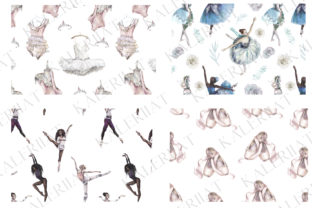
If you’ve ever scrolled through design marketplaces searching for something that feels both elegant and expressive—something with the softness of watercolor but the precision of ballet—you’ve probably landed on the Watercolor Ballet Patterns Set. It’s not just another clipart bundle. It’s a thoughtfully curated collection of hand-drawn, high-resolution PNGs featuring ballet dancers, pointe shoes, tutus, ribbons, leotards, rehearsal bars, and delicate floral motifs—all rendered in gentle watercolor washes, scanned at 3000 x 3000 px, and delivered with transparent backgrounds at 600 DPI.
Where This Set Fits Into Real Creative Work
This isn’t about filling space—it’s about adding emotional texture. Designers, educators, small business owners, and crafters reach for the Watercolor Ballet Patterns Set when they need visuals that carry grace, movement, and quiet confidence—not sterility or stock clichés. Think of it as visual shorthand for discipline, artistry, and transformation.
A wedding stationery designer might layer a watercolor ballet slipper over ivory vellum to evoke a first dance theme without saying a word. A dance studio owner could use the pointe shoe illustrations to create custom class schedules, progress charts, or parent newsletters that feel personal and polished—not generic. Even therapists specializing in body awareness or movement-based counseling sometimes print these patterns on journals or wall art to gently reinforce themes of balance, poise, and self-expression.
Who Uses It—and Why It Stands Out
Small-business owners love this set because it bridges professionalism and personality. You won’t find stiff vector icons here—just organic, slightly imperfect strokes that suggest human hands and real effort. That makes it ideal for branding a boutique dancewear line, a yoga-and-movement retreat, or a children’s creative movement program. The transparency means no awkward white boxes around dancers when placed over textured paper or soft gradients—a subtle but critical detail when designing packaging, social media banners, or email headers.
Educators and curriculum designers use individual elements (like a single watercolor ribbon or a pair of crossed pointe shoes) to illustrate lesson plans, reward charts, or classroom posters. Because each image is 3000 x 3000 px, it scales beautifully—even when printed large on bulletin boards or laminated for student handouts. One teacher told us she prints the dancer silhouettes on cardstock, cuts them out, and uses them as “movement cards” during warm-ups: “It’s more inspiring than clipart—and kids notice the difference.”
Print-on-demand creators rely on the 600 DPI resolution for crisp results on fabric, greeting cards, and fine art prints. Unlike lower-res downloads that pixelate when enlarged, these hold detail even at 12x12 inches—so a watercolor tutu pattern looks luminous on a silk scarf, and a dancer mid-pirouette stays sharp on a gallery-wrapped canvas.
Practical Considerations Before You Use It
Because the set is hand-drawn and watercolor-based, colors shift subtly across elements—some dancers have cooler lavender washes; others lean into warm peach or dusty rose. That’s intentional. It adds depth and avoids visual monotony—but it does mean you’ll want to preview how pieces interact if you’re building a cohesive layout. For example, pairing a cool-toned barre motif with a warm-toned costume graphic may require a light color overlay or background unifier.
The transparent background is a huge plus—but also a reminder: these aren’t layered PSD files. Each PNG is a single flattened illustration. So while you can easily drop a dancer into Canva or Illustrator, you can’t isolate her tutu from her arms without manual masking. That’s fine for most use cases (invitations, web graphics, apparel), but less ideal if you need modular, editable components like separate ribbons, bows, and bodices for complex compositing.
Licensing matters too. Most versions of the Watercolor Ballet Patterns Set include extended commercial rights—meaning you can use them in client work, sell products featuring the designs, or include them in digital templates. But always double-check the license terms before uploading to marketplaces like Etsy or Creative Market. Some sellers restrict use in *resellable design assets* (e.g., editable Canva templates), even if physical products are allowed.
Industries and Moments Where It Adds Quiet Impact
In publishing, editors use these patterns to soften chapter dividers in memoirs about performance, growth, or recovery—or to add tactile warmth to poetry collections centered on the body. One indie publisher told us they used a watercolor ballet barre motif as a subtle divider between sections of a book about chronic illness and reclaiming movement. “It wasn’t literal—it was symbolic. And readers kept mentioning it.”
Event planners working with dancers, choreographers, or arts nonprofits often build mood boards using these images—not as final assets, but as tonal anchors. A soft watercolor dancer against blush linen? That becomes the starting point for fabric swatches, lighting choices, and invitation typography.
For therapists and somatic practitioners, the set offers non-clinical visual language. A watercolor pointe shoe beside a breathing exercise prompt feels inviting—not prescriptive. It signals care, attention to form, and respect for embodied experience—without leaning into medical or athletic imagery that some clients find alienating.
What Makes It Different From Other Dance-Themed Graphics
You’ll find plenty of ballet vectors online—clean, scalable, and consistent. But consistency isn’t always what you need. The Watercolor Ballet Patterns Set trades uniformity for authenticity. The slight bleed of pigment, the visible paper grain in some scans, the variation in line weight—it all whispers “handmade,” which resonates deeply in spaces where trust and humanity matter more than polish.
It’s also unusually versatile in scale. Need a tiny watermark for a digital course? Use a 150-pixel version of a ribbon motif. Printing a 24x36-inch poster for a recital lobby? The same file holds up—no blurring, no jagged edges. That dual-purpose flexibility saves time and eliminates the need to juggle multiple resolutions or formats.
And unlike AI-generated ballet art—which often flattens gesture, misplaces anatomy, or renders costumes with uncanny stiffness—these are drawn by someone who understands how a foot arches in relevé, how tulle catches light, how ribbons twist mid-air. That lived-in knowledge shows up in the details: the subtle curve of a wrist, the way watercolor bleeds softly under a satin bow, the quiet dignity in a dancer’s downward gaze.
One Last Thought on Use
You don’t need to be a dancer—or even particularly familiar with ballet—to find value in this set. What it offers is a visual vocabulary for intentionality: the kind of focus that comes before a leap, the stillness inside motion, the beauty in repetition and refinement. Whether you’re designing a wellness app interface, illustrating a children’s book about trying new things, or creating a gift box for a graduating dancer—the Watercolor Ballet Patterns Set gives you tools that feel meaningful, not merely decorative.